A simulation study of how Mosaic is actually played.
1,000,000
complete games played
Three AI seats plus two imaginary players (dealt goals and hands, never acting, never winning), zero humans. Each game seats
three AI players drawn from a pool of six distinct personas —
never a duplicate at the same table:
The Honest One · The Liar · The Hoarder · The Spender · The Hunter · The Opportunist
These are not language models. Nothing here is trained.
This is agent-based modeling of a board game, with generative AI as architect and
analyst — an ongoing instrument for understanding how strategy, information, and deception
emerge from the rules. Three standing questions:
Do personality-driven agents actually behave in character?
Is the game structurally fair?
Is deception mechanically real strategy?
Current findings, in one line: goal colours are remarkably balanced,
turn order carries a modest first-player edge (+1.6
points over moving last), and straightforward play is currently outperforming sustained bluffing
(38.8% vs 27.2%).
The headline numbers
One batch, one master seed, three persona bots per table (drawn without repeats from the six).
20,271,100
moves simulated
17
median moves / game
+1.6pp
first-mover edge over moving last
48.3%
wins where an opponent had proven the winner's goal
48.5%
wins where the winner's goal never changed hands
The shape of a game
20,271,100 moves break down into
14,853,285 pattern placements (14.9/game) and
5,282,009 actions (5.3/game) —
per-tile and per-action detail below in Every card's story.
6
fastest win (moves)
17
median game
86
longest game won by a chain
98
longest game of all
What "tile exhaustion" means. There is one shuffled draw pile of all 66 tiles —
45 patterns and 21 actions mixed together, minus the 15 dealt
into hands — so nothing "runs out first". When that single pile is empty and every player passes in
turn, the game ends and the longest chain wins. It's rare: 1.4% of games here.
How a victory gets shared. One move can complete seven-chains for more than
one colour at once — a single tile bridging two finished runs. By rule, that moment crowns a
single winner: the first qualifying seat in turn order from the player who moved. So shared
victories arise one way: exhaustion ties. All 6,619 shared
victories here were exactly that (6,619 of the
13,616 exhaustion endings were ties).
Why so few action plays, with three copies of each? Because most of the deck never
leaves the pile: on average 26 of the 51
pile tiles are still face-down when the game ends — the chain race finishes long before the deck
does, so typically fewer than two copies of any action even reach a hand. And an action costs
its player's placement that turn (with some personas hoarding what they draw), so roughly half
the actions that do reach a hand are still being held when the game ends.
Is moving first an advantage?
Win rate by turn position — counted across the real players only; the imaginary seats hold goals, never turns. Seats rotate who moves first across the batch, so position separates cleanly from seat.
Turn order
Victory share by position in the turn order, n=1,000,000 games
(shared victories credited 1/k). Dashed line: the 33% a perfectly
fair table would give every position.
Does any colour win more?
Goal colours are dealt randomly, so this measures the tiles and the board — not the players.
Two views of the same result:
Colour fairness
Chance each colour wins a game. Shared victories count for every winning
colour, so these sum slightly above 100% — the overshoot is the shared-victory rate,
explained below.
Colour fairness
Each colour's share of all victories — normalized, sums to exactly 100%.
Fairness claims on this page use this view. In-game, colours can be re-themed freely — these
are the default set.
The shared victories behind the overshoot
6,600 of 1,000,000 games
(0.7%) ended with multiple winners — every one an exhaustion tie: the deck
ran out with two or more chains at equal length (a completed seven-chain always crowns exactly
one winner, by rule). Real, not rounding noise — and exactly the amount by which the left chart
exceeds 100%.
Which colours tie together: across 9,949 co-winning pairs, the most
common are G+M (1,048), B+G (1,020), B+R (1,013). The mesh is essentially flat (942–1,048
per pair, within noise) — and the hidden pentagon, so loud in the bonus economy, is silent here
(4,999 along the cycle vs 4,950 across).
Ties are blind to colour structure.
The personas
Six personalities over four parameters. Three sit at each table. All six perceive the
board identically (the same "skilled" awareness — public information only, no cheating) and all take a visible
win instantly; personality is how they build, spend, bluff, and block — never what they can see.
Persona — BuilderThe Honest One
Never feints: every placement is scored for its true goal, full weight, from the first turn. Spends actions on an ordinary mid-game clock and blocks only what plainly needs blocking.
Bluff0.00
Patience0.40
Aggression0.30
Greed0.50
“The shortest path to seven is a straight line.”
Persona — DeceiverThe Liar
Until the mid-game, nine turns in ten it builds a decoy colour it was never dealt — paying real tempo to be misread. Prizes Rotate and Trade Goals, the tools that can make the lie come true. Still takes a visible win instantly, even mid-bluff.
Bluff0.90
Patience0.50
Aggression0.40
Greed0.50
“Everything it shows you is a choice.”
Persona — CollectorThe Hoarder
Sits on its action tiles until the endgame — or until a chain crosses the threat line, which panics it into spending. All those quiet turns go into placements: it out-builds and out-draws every other persona.
Bluff0.35
Patience0.95
Aggression0.50
Greed0.50
“Later is when everything is worth more.”
Persona — TempoThe Spender
Fires actions the moment they arrive — the board rarely stays the way an opponent left it. The cost is fewer placements of its own; the payoff is a table that can never settle.
Bluff0.30
Patience0.05
Aggression0.40
Greed0.50
“A tile in the hand is worth nothing.”
Persona — BlockerThe Hunter
Scores every placement against the biggest rival chain and reaches for Remove Pattern the moment one crosses its threat line — pressing 2.5× harder when it can prove whose chain it is.
Bluff0.25
Patience0.60
Aggression0.95
Greed0.30
“Your chain looks lovely. It would be a shame.”
Persona — HarvesterThe Opportunist
Weighs every placement by the bonus tiles it earns — multi-colour connections above all. Its game is an engine: more draws, more options, more board.
Bluff0.40
Patience0.50
Aggression0.20
Greed1.00
“Every connection pays somebody. Make it pay you.”
Personas
Win rate per persona across every game it played. The dashed line is the fair-share baseline.
Style fingerprints
Persona
Actions played / game
Bonus tiles / game
Patterns placed / game
The Hoarder
0.71
2.26
5.72
The Honest One
1.98
1.90
4.82
The Hunter
1.38
1.97
5.27
The Liar
1.67
1.74
4.91
The Opportunist
1.68
2.02
4.97
The Spender
3.14
1.53
4.01
Style fingerprints — the behavioural signatures behind the win rates.
Two games, end to end
The extremes of the corpus, re-simulated from their recorded seeds and rendered from the
game's own tile art. Every game in the batch can be reproduced this way.
Scenario · the fastest win
The same game as a race: each colour's chain, move by move
Goal RGoal GGoal BGoal YGoal M
The fastest win — 6 moves (seed 10,002,288).
Seven connected in barely more than one lap of the table; the race is a sprint from the deal.
Scenario · the longest chain victory
The same game as a race: each colour's chain, move by move
Goal RGoal GGoal BGoal YGoal M
The longest chain victory — 86 moves (seed 10,107,920).
A war of attrition: chains fall as well as rise (removals, moves, and rotations undo work),
and the game ends the instant any line touches seven.
These are single-game timelines, not averages — each chart belongs to the
board beside it.
The footprint
Where the games actually happen: every cell a pattern landed on, across the whole corpus,
centred on the Prism (outlined). North is up; placement rules have no compass, and the glow says the
games don't either.
Tile landings per cell (log-shaded), all games overlaid. The average game's bounding
box is just 23.1 cells of coordinate space.The most sprawling board — a 10×12 bounding box
(120 cells, seed 70,102,012). The
farthest any tile has landed from the Prism: 10.05 cells away, at
(10,-1).
The colour mathematics
The physical tile set, measured exactly — including a structure nobody put there on
purpose.
Perfect balance, by construction. Every colour appears on exactly 24 of the 45
patterns, as exactly 24 segments, carrying exactly 51 connection points — and
the equality holds inside every family (4 points per colour in the solids, divides, x and slash
tiles; 6 in windows and hooks; 7 in stacks; 8 in lanes and grids). The flat win-by-colour chart
above isn't luck; it's arithmetic.
The hidden pentagon. The ten colour pairs can't all be equal — and they miss
by the smallest possible structure. Arrange the colours in the cycle shown: neighbouring colours
share a tile 13 times (solid lines); colours across the pentagon share 11
(dashed). Every colour gets exactly two 13-neighbours and two 11-diagonals, so no colour gains an
edge — the asymmetry lives entirely between pairs.
The arithmetic makes the near-miss precise: the 45 tiles produce
Σ C(k,2) = 120 pair co-occurrences across ten pairs — so a
perfectly uniform 12 apiece was numerically possible. The set landed one step away, at
13/11 along a cycle. In plain terms: a design made by feel came within a single tile-swap of
perfect uniformity, and the residue it left behind is a pentagon.
Micro-question, resolved by the corpus: two-colour
bonuses split 3,614,967 along the 13-cycle to
2,004,349 across the 11-diagonals — a per-pair ratio of
1.80 against a tile-supply ratio of 1.18.
Play amplifies the pentagon beyond its tile supply — the structure has gameplay consequences beyond the deck itself.
How big is the game?
The possibility space and its information theory — rule constants from the engine,
joined to the live corpus.
165
distinct placeable tile-states (45 patterns × orientations; the five solids are rotation-proof)
31.7%
of all edge pairings legally connect (10,056 of 31,680)
81
legal moves per turn on average (median 66, p90 150, max seen 456)
5.4×1024
distinct opening deals (hands × goals)
~1032
game-tree playouts at median depth (81 choices × 17 moves)
Spatial combinatorics — measured fairly. Compared metric-for-metric with the classics,
Mosaic's reachable universe — every legal deal times every way its games can legally
unfold — is about
1024 deals × 1032 playouts ≈ 1056 possible games
On the same legal footing: the chess game tree runs to ~10120 and legal Go positions
to ~2×10170. Mosaic sits below both — its games are short and sharp by design —
and the space is still beyond physical intuition: the opening deals alone
(5.4×1024) outnumber the stars in the observable universe several times over, and
the full reachable space (1060) is some ten billion times the atoms in planet Earth
(1050) — though still short of the universe's 1080 atoms, which is what
measuring honestly permits us to say. And since every game is
deterministic given its seed, that universe already contains every outcome — the lab doesn't create
results, it reads them out of a function too large to enumerate.
One number we deliberately do not compare: strip away the rules — legality, even the
fact that each tile exists once — and the raw arrangements of the observed play window run to
(P+1)S = 166441 ≈ 10979. That
figure isn't on the same metric as anything above, so we cite it only for its ratio: the placement
law prunes roughly 920 orders of magnitude of chaos to produce the game. Raw bounds impress;
legal bounds inform.
Game-tree complexity. With effective branching factor b ≈ 81
and median depth d = 17, a median game sits in a
tree of roughly
bd ≈ 8117 ≈ 1032
playouts. The 1,000,000 games below are a vanishing, deliberately-sampled
sliver of it — uniquely seeded and fully reproducible, which is what makes the sliver trustworthy.
Shannon entropy — why bluffing is a wasting asset. Uncertainty has a unit, and the game
starts full of it:
H(X) = −Σ p(xi) log2 p(xi)
At the deal, the hidden state is at maximum entropy: the four unseen goals hold
log2(4!) ≈ 4.6 bits per observer, and the shuffled pile
alone holds log2(51!) ≈ 220 bits. Every draw, placement,
trade, and rotation leaks information, and entropy only falls — the game's "now" grows steadily more
determined. The corpus shows the collapse in action: by the moment of victory,
winners have provably resolved 0.8 opponent goals on average, and
48.3% of winners have themselves been identified.
This is the arithmetic behind The Liar's problem: a bluff is worth most exactly when entropy is
highest, and that window only ever narrows. (Whether opponents that model intent can
re-widen it is the theory-of-mind experiment in the queue.)
The collapse, measured: hidden information in the pile, move by move
Average entropy of the undrawn pile's hidden order (log2 pile!), across all
games still running at each move. The deal starts near 220 bits and every draw burns some — the
curve is H(X) doing exactly what the formula promises. (Hands and hidden goals add bits not shown;
their collapse is the deduction layer's story above.)
Infinity isn't quite infinity — but it's close
What is the likelihood that you'll ever play the same game twice?
The birthday problem answers it. Draw n games from a space of
N possibilities, and the chance any two match is
p ≈ 1 − e−n²/2N
which reaches even odds only around n ≈ 1.18 √N.
The plain readings:
To repeat a deal — the same five hands and five goals, before anyone chooses anything —
takes about 2.7 trillion games for a coin-flip's chance: every human on Earth playing one
game a day for about a year, with every game recorded and compared. And that repeat would diverge
on move one.
To repeat a game — same deal, same moves, beginning to end — takes about
1030 games: all of humanity playing daily for roughly
400 quadrillion years, some thirty million times the age of the universe. Every game of
Mosaic ever played is the only time that game will ever happen.
Even inside this corpus: had its 1,000,000 games
been dealt at random, the chance that any two of them shared so much as a starting deal is about
1 in 10,800,000,000,000.
The bonus ladder
Connect 2 colours with one placement → draw 1 tile; 3 → 2; 4 → 3. How often does each
rung actually happen?
1 in 3
placements connect 2 colours (5,619,316 times)
1 in 65
connect 3 colours (227,786 times)
1 in 5,249
connect 4 colours (2,830 times)
6,083,378
bonus tiles paid out
The tutorial calls the four-colour connection "a feat worth planning for" —
the corpus agrees: it is the rarest event the game produces. In expectation:
E[bonus] = Σ rung × rate ≈
0.41
tiles per placement — in plain terms, every tile you place carries roughly a
41%
chance-weighted dividend, which is why the draw economy never stalls.
Every card's story
How often each action and pattern hits the table — and how often it is the move that ends the game.
Win credit goes to the final move of a chain victory (exhaustion endings have no single winning move).
Top finishers — patterns
1x-1y1g1b1m22,326 wins (2.3%)
2x-1r1y1m1g22,310 wins (2.3%)
3x-1b1r1g1y22,300 wins (2.3%)
Top finishers — actions
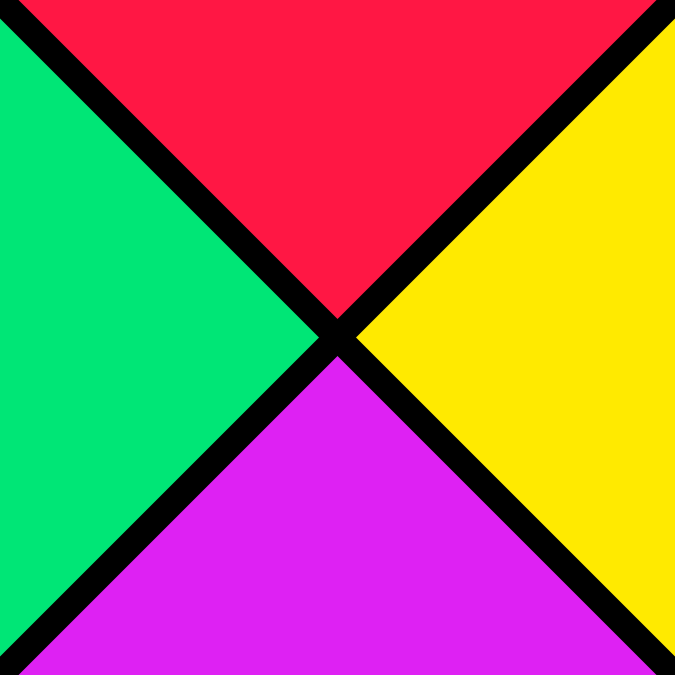
1Rotate pattern122,453 wins (12.4%)
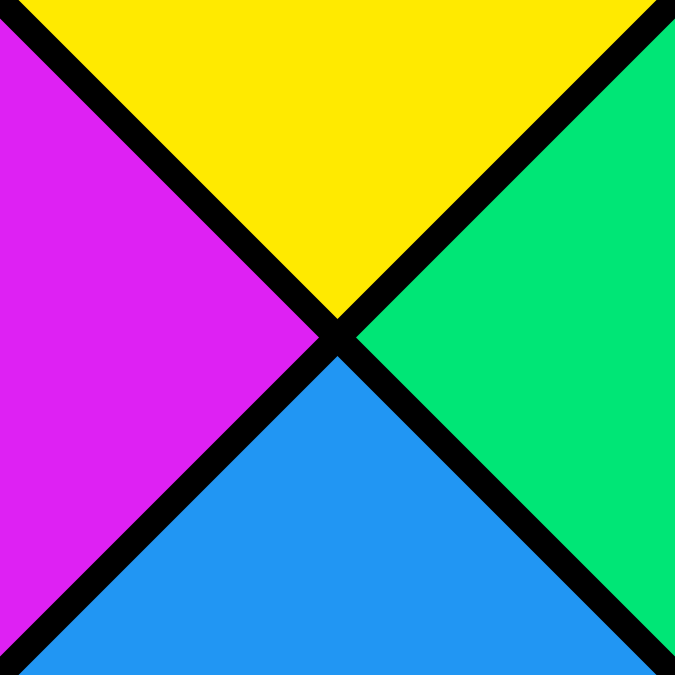
2Move pattern111,404 wins (11.3%)
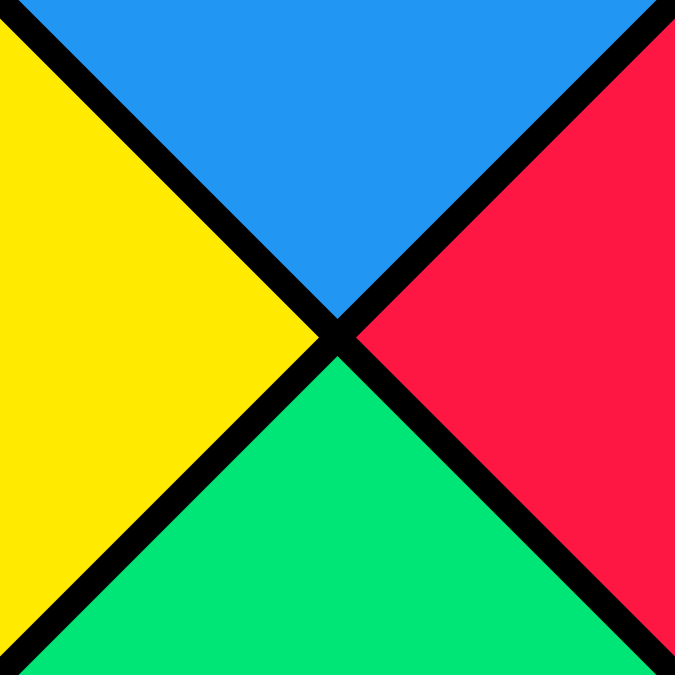
3Trade goals22,961 wins (2.3%)
Read the finishers list carefully — the real finding is flatness.
Per play, every pattern family ends between roughly 3.9% and 5.7% of the games it appears in; the
x family's #1 spot is an 8% edge over divide, not a queen among pawns. Finishing turns out to be a
different job from building: the game ends on any legal +1 at one frontier cell (players take a
visible win instantly), so the last move rewards fit — and the x, one segment in four
colours, matches the most junctions, while its weaknesses (no follow-up, feeds neighbours) cost
nothing on a move that ends the game. Building strength shows up exactly where it should instead:
grid and lane are the most-played tiles in the game — the mid-game engines — while the solid, the
strongest cap in principle, is the least-played because a single colour is the hardest
contact to find legally. Within each family the five variants are colour-permutations of each other —
formally, E[wins(σ·t)] = E[wins(t)] for any colour permutation
σ, because the deal treats all colours identically. In plain terms:
the five x tiles are the same tile wearing different paint, so the mathematics forbids their win
counts from differing — and they don't. A built-in correctness check on the pipeline.
Crawl or bridge? Not every win is a 6→7 crawl — a single
tile can weld separate groups into a winning chain. In this corpus, 78.8% of chain wins are +1 crawls and
21.2% are bridges of +2 or more — and in the bridge wins the finisher mix
flips toward the strong connectors: rotate-pattern (49,424), slash (24,078), window (22,606), move-pattern (20,268). The x is only the king of the crawl;
whether deliberate planners bridge more often is a standing question for the search-agent phase.
Remove pattern0.91 plays/gamewon 0 games (0.0%)
Move pattern0.99 plays/gamewon 111,404 games (11.3%)
Rotate pattern0.92 plays/gamewon 122,453 games (12.4%)
Rotate goals0.66 plays/gamewon 8,711 games (0.9%)
Trade goals0.76 plays/gamewon 22,961 games (2.3%)
Trade tiles0.57 plays/gamewon 0 games (0.0%)
Reverse direction0.47 plays/gamewon 0 games (0.0%)
Every printed card
solid
0.201.0%
0.201.0%
0.201.0%
0.201.0%
0.201.0%
divide
0.322.0%
0.322.0%
0.332.0%
0.322.0%
0.322.0%
x
0.352.3%
0.352.3%
0.352.3%
0.352.3%
0.352.3%
slash
0.291.7%
0.291.6%
0.291.7%
0.291.6%
0.291.6%
window
0.331.4%
0.321.4%
0.331.3%
0.331.4%
0.331.4%
hook
0.321.3%
0.321.3%
0.321.3%
0.321.3%
0.321.3%
stack
0.371.7%
0.371.7%
0.381.6%
0.361.7%
0.361.7%
lane
0.381.6%
0.381.6%
0.381.6%
0.381.6%
0.381.6%
grid
0.401.9%
0.411.9%
0.411.8%
0.401.9%
0.401.9%
Per tile: plays per game, then (in blue) its share of the 986,384 game-ending moves.
And this table has something no full table can produce: the orphan-chain
steal. With imaginary seats holding goals they can never win with, a finished chain can sit
unclaimed on the board — until Trade Goals takes it (22,961 wins) or Rotate Goals
delivers it (8,711). Nearly every one is a victory built by nobody at the table
and claimed by whoever moved first.
What we're seeing so far
Finding No goal colour strays more than 13.4 points from the 33%
a perfectly even split would give it, seat effects are similarly small, and moving first is worth
+1.6 points over moving last — a real edge, small but past the noise band at this sample size.
Interpretation In game-balance terms, Mosaic looks sound: the materials and the seating aren't deciding winners, and
the only edge the table itself grants is a slight one to whoever moves first. (That is a claim about
the deck and the table, not about strategies being equally strong — the persona gaps below are real.)
Next experiment Controlled ablations — removing single mechanics (actions, goal exchanges, different chain lengths) to
see which ones carry the balance.
Finding The style fingerprints separate exactly as parameterized: The Spender fires 3.1
actions per game while The Hoarder sits on 0.7, converting its quiet turns into
the most placements (5.7/game) and bonus tiles (2.3/game) at
the table.
Interpretation The personality knobs produce genuinely distinct playstyles under real play — six players, not six
names for one player.
Next experiment A persona matchup matrix: who beats whom head-to-head, and whether some personalities only thrive at
particular tables — an ecology, not a ranking.
Finding The Honest One currently tops the table at 38.8%; The Liar
trails at 27.2%. On the bluff axis specifically: The Honest One (bluff 0.0) wins
38.8%, The Liar (bluff 0.9) 27.2% — last in 2 of the six table
compositions.
Interpretation Against opponents whose defence reads the board rather than the player, sustained bluffing
pays real tempo to hide a fact they barely use. Deception's value likely begins where opponents start
modeling intent.
Next experiment Theory-of-mind agents — opponents that infer goals from behaviour and hold probabilistic beliefs —
plus an awareness sweep from novice to oracle.
Finding In 48.3% of victories, at least one opponent had proven the winner's goal
(via the same deduction the in-game map shows) before the final move; 51.7% were
stealth wins. Winners had proven 0.8 opponent goals on average at the
moment of victory.
Interpretation At this level, knowing beats hiding: winners tend to be the best-informed players at the table, and
being identified doesn't stop a strong chain.
Next experiment Track goal-inference accuracy over time within games, and test whether theory-of-mind opponents can
convert identification into effective defence.
Finding Goals changed hands 4.8 times per game; only
48.5% of victories kept one goal the whole game
(24.4% weathered one change, 27.1% two or more, and
7.0% ended on the dealt colour only because it left and came back).
When a winner's goal moved, the arriving colour carried a 3.9-chain
on average against 3.5 for the one leaving.
Interpretation The goal-shuffling actions are half the game: victories ride inherited work as often as built work.
Next experiment The three-player table (two imaginary seats) — already queued — where an orphaned finished
chain can sit unclaimed until a rotation or trade takes it, letting goal actions win games outright.
Method: three persona bots per table at skilled awareness, drawn
without repeats from the six (composition recorded and conditioned on). Every game plays its own
unique seed; the whole batch reproduces from one master seed. At the current
1,000,000 games, a 33% win rate carries a 95%
confidence interval of about ±0.1 points
(1.96 √(p(1−p)/n) — in plain terms, at this scale the
error bars are thinner than the bars). All prose on this page is
regenerated from the live data with every update — last refreshed Sat, 05 Sep 2026 18:02:34 GMT.
The experiment queue
Mosaic Lab is an instrument, not a report — these are the studies lined up behind the
current batch.
Smaller tables (queued — starts automatically when this batch completes). A second million
games at three real players plus two imaginary seats. Imaginary players hold goals but can never win,
so a finished chain can sit orphaned on the board — the configuration where Rotate and Trade Goals
can end games outright.
The awareness sweep. The same personas from novice to oracle perception: does bluffing
start paying once opponents are perceptive enough to be worth deceiving?
Theory-of-mind agents. A new pool that reasons about players instead of only the
board — inferring goals from behaviour, holding probabilistic beliefs, remembering who did what.
The test of whether deception becomes real strategy against minds that model yours.
The persona matchup matrix. Head-to-head performance for every pair, conditioned on table
composition — looking for counters and ecologies rather than a single ranking.
Playing without the Prism. A million games with the open start (no wild centre tile) at
both table sizes. No common anchor means no neutral first move: opening placements commit to real
colours immediately, bluffing gets more expensive to hide, and passes appear when nothing connects.
The paired-seed design lets us diff these directly against the Prism batches, game for game.
Ablation studies. Rule variants with single mechanics removed — no actions, no goal
exchanges, different winning chain lengths — to measure what each mechanic contributes to balance
and drama.
Distributions, not just averages. Game-length histograms, action-timing curves across the
arc of a game, inference-accuracy over time, and variance within each personality.


 Remove pattern
 Rotate goals
 Trade tiles
 Reverse direction